It’s all one skin and bone,
one piss and shit,
one blood, one meat.
From one drop, a universe.
Who’s Brahmin? Who’s Shudra?
-
Kabir (15th century Bhakti saint)
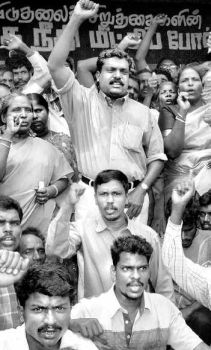
Today there are around 200-250 million Dalits in India with 75-80% of them below the poverty line(1) and backward castes as a whole (Dalits, tribes, etc.) forming close to 52% of the population of India.(2) Needless to say caste oppression in India is probably the greatest injustice still existing in, and haunting, that society today. I come to this subject as an outsider (in every sense of the word, I’m a white Christian American male!) looking in not knowing the full intricacies that effect lower caste and non-caste Indians, nor do I pretend to know or try and talk about subjects that are outside of my realm of knowledge. I’m writing this essay because of a Reuters article that came out in August and that appeared in
Al Jazeera which perked my interest in the subject of caste. Although I may be critiquing caste in Indian society I do not mean to degrade the great and ancient religious tradition that is Hinduism nor do I mean to impose my religious beliefs (I follow the school of thought of Liberation Theology in the Christian tradition) onto those who follow the Hindu tradition because I recognize that many Christians have done this in the name of liberating people from the horrors of caste oppression. I’m not so narrow minded and simple to think that Christianity is the answer to caste oppression in India, in fact, I recognize that even in Christian communities and churches priests and worshipers still follow the caste system and still oppress people on the basis of caste, even though they claim to have liberated people from the rigid structures of caste.(3) In order to overcome the evils of caste all Indians have to do is to just look at their own traditions (not to Christianity) in order to see that there are liberating schools of thought within those traditions, and this is indeed what many have done over the centuries, whether it was Swaminarayan (1781-1830) who got rid of caste in his community of followers, Vivekananda (1863-1902) who preached that the downtrodden needed to be uplifted and that the caste distinction needed to be rid of, or the great B. R. Ambedkar (1891-1956), the militant Dalit who ferociously fought against all forms of caste discrimination and latter converted to Buddhism (with 200,000 of his followers) claiming that Hinduism was so corrupt and oppressive that he could no longer consider himself Hindu. All three Indians, and many many more, fought against the caste system and/or caste distinction (all though Swaminarayan and Vivekananda were from the Brahmin caste with only Ambedkar being outside of the caste system, a Dalit), while I won’t take up the line that Ambedkar did (that Hinduism was hopelessly corrupt and evil) I will be critiquing that aspect of Hinduism. Again, as I’ve said above, I am an outsider looking in, a non-Hindu, so because of this my criticisms will not be as harsh as are my criticisms of Christianity because I don’t want to be mistaken as criticizing the Hindu religion as a whole, which is not at all my intention.
The caste system is as old as the Hindu religion itself, in fact, it even predates Hinduism by some centuries. One important thing to know about the caste system is that it was brought into the Indus Valley from the outside by a tribe of semi-nomadic people called the Aryans (the “Noble Ones”), who originally inhabited the steppe country of southern Russia and Central Asia and entered India, through the Indus Valley, around the year 1500 BCE.(4) The Aryans had a linear sense of time and had a structured caste system with three sets of castes (warrior caste on top, followed by a priestly caste, and then everyone else) and a plethora of mostly male gods, the language that the Aryans spoke was Sanskrit which latter became the basis for Hindi. When the Aryans invaded the Indus Valley the people of the Indus Valley had a religion with no caste system, a circular sense of time (hence the Hindu concept of reincarnation, etc.), and a pantheon of female goddesses.(5) The fact that the outsider Aryans introduced India to the caste system and was a warrior-centered culture that had a reverence for male gods is one of the reasons why scholars, such as Kalpana Kannabiran argue that “patriarchy is in fact the basis of the caste system and that the patterns of hierarchy, power and authority which characterise the caste system are derived from earlier forms of gender-based oppression.”(6) When the Aryans first invaded the Indus Valley they called the Indus Valley people (Indians) Dasa (Sanskrit for dark-skinned) and the three-tier caste system was morphed into a four-tier caste system called the Four Varnas (which means color); Brahmins, the priestly class were now on the top, Ksatriyas, the warrior class were now below the priests, then their was the Vaishyas, skilled labor, and the Sudras, unskilled labor. Outside of the caste system were the non-Vedic peoples and the Dalits (the untouchables). Originally the lighter one’s skin color was the higher up in the caste system one was (with the Aryans obviously being at the top of the system) and the higher up in the caste system one was the more “pure” that person was (purity was of a huge concern of the Indus Valley people with many ritual and private baths having been excavated).(7) The majority of the people in the Indus Valley fell within the lower castes which can be seen today since 77% of Indians comprise these lower castes (as well as Dalits, scheduled castes/scheduled tribes [SC/ST], etc.).(8) What this mini-history lesson shows us was that the concept of caste is a concept that was brought into India by outside forces (the patriarchical and warrior culture of the Aryans) which then incorporated itself into the civilization of the Indus Valley people through the Vedas (specifically the Rg Veda). The Aryans and Brahmins needed a system to keep themselves on top and the majority of the dark-skinned Indus Valley people at the bottom, the caste system was the perfect way to do this, and in fact this had been the case until around 500 BCE when the traditions of the Vedas and the Brahmins began to be attacked by Hindu ascetics.(9)
From around 600 BCE to 200 BCE there was an incredible Vedic development in the Hindu tradition (a philosophic development) which can be described as the “democratization of Hinduism.” Out of this philosophic development came the Upanisads (upanisad implies “sitting at the feet of the teacher,” Upa=down, Ni=near, and Sad=sit).(10) The Upanisads were focused on attaining the mystical knowledge that would free a person from “re-death” or punarmrtyu. The Brhadāranyaka Upanisad placed emphasis on the knowledge of the cosmic connection underlying ritual. “When the doctrine of the identity of atman (the Self) and brahman was established in the Upanishads, the true knowledge of the Self and the realization of this identity...substituted the ritual method.”(11) Asceticism started becoming more widespread (which was one the factors leading to the creation of the latter Upanisads) in reaction to the rigid doctrines of the Brahmin and of the Vedas. What’s important to note as that even though these ascetics were critical of the Vedas and scathing in their critiques of the Brahmins they were still very much Hindu in nature (in fact, they probably didn’t consider themselves anything else, all though the term Hindu wasn’t around then) and their philosophical teachings and thought derived from the Vedas. These ascetics denied that only Brahmins could receive bliss and escape reincarnation and stated that through giving up the world and all desires anyone, whether Dalit or Vaishya, could attain psychic security, or rather, liberation through the attainment of unification with Brahman. Out of reaction to this the Brhamins devised a doctrine called the four asramas (abodes) which dived the life of the “twice born” into four stages” which would keep asceticism in check by confining it to middle-aged males.(12)
On top of these ascetics came leaders who led offshoots of Hinduism and breakaway sects such as Siddhartha Gautama (the Buddha) and Vardhamana (Mahavira, the great teacher of Jainism). These two leaders rejected not only the pleasures of the world, but more importantly, they rejected the claims of the Brahmins and the ritualistic Brahminic schools who claimed authority and superiority over other Hindus and Indians by claiming to be pure and to have the right to perform traditional rituals and sacrifices, as well as having the rights to interpret their meanings. While the Buddha rejected Hinduism (as well as religion) all together, Mahavira kept to the central aspects of Hinduism while abandoning the rituals that allowed the Brahmins to dominate all aspects of life. Mahavira stated that through one’s own efforts one could attain liberation and freedom from rebirth,(13) short of the Buddha, this was one of the most complete rejections of the Brahmins (and in turn their belief in ritual purity and caste) that anyone could have ever articulated.
All of this now brings us to today and to the subject of the liberation of Dalits and to the subject of my final blog in this series, a Hindu Liberationist perspective on the plight of Dalits and of their liberation from caste oppression. What disturbed me about the student protests against the further admission of lower caste and SC/ST students was that these high caste students had the wrong premise that the oppression of lower caste and SC/ST peoples was the “correct” form of Hinduism and the only form that should be practiced (all though I do recognize that some of these students could have been playing the “caste card,” claiming caste privilege in order to protect their privilege in society). Yet we have seen in the ancient history of Hinduism that caste was an outside concept placed upon the Indus Valley people by an outside tribe of semi-nomadic pastoralists, this shows us that the concept of caste didn’t grow “organically” from Indian soil but was imposed from the outside, and hence, the shedding of caste ideology and caste oppression would in a sense mean the shedding of outside Aryan domination against the Indian peoples, of course many high caste Indians still adhere to their Aryan roots and view their Brahmin status as a source of pride, not something to overcome in order to help out their lower caste and Dalit sisters and brothers. Despite the seemingly set in stone concepts of caste in the Rg Veda many Hindus over the preceding centuries fought back against the Brahminic elite and questioned the writings of the Vedas, especially the writings on ritualistic purity (a major concept in caste ideology) and on the “privileges” of the Brahmin caste. Whether it was the radical Siddhartha Gautama, who renounced Hinduism, or Vardhamana, who used acetic concepts of Hindu thought to criticize the present day establishment, thoughtful Hindus and the ever evolving Hindu religion never laid down and accepted the perverse policies of the Brahmin and their constant quest for power. Because of this we can see that Hinduism was never a monolithic religion that accepted the Vedas sayings on caste and ritual as blindly as present day Hindu nationalist BJP (Bharatiya Janata Party) and RSS (Rashtriya Svayamsevak Sangh) supporters would like us to think. History has shown us that a thoughtful and pious Hindu can be one who rejects certain ideas of Vedic thought that are oppressive and evil and history has also shown us within the Hindu tradition there has always been an ever evolving struggle for freedom against the Brahminic caste in the realm of the physical and the realm of the spiritual, such as reclaiming concepts of freedom from rebirth and attaining liberation by being joined with Brahmin. With this in mind I will now actually tackle (in part
VI, the final part, of this series) the problems of the caste system and the oppressions Dalits have faced over the centuries (especially the 20th century and now) and how Dalits will be the ones to actually bring about change in this present day situation and how Dalits are the only ones to bring about their own salvation (not from outside help from people such as Gandhi or someone like myself) and how the Hindu religion plays a role in this, and how it can play a liberating role instead of the role of oppressor.
Endnotes
1. Grey, Mary, “Dalit Women and the Struggle for Justice in a World of Global Capitalism,” The
Journal of Britain & Ireland School of Feminist Theology 14, no. 1 (Sept. 2005): 129.
2. Ghose, Sagarika, “The Dalit in India,” Social Research 70, no. 1 (Spring 2003): 84.
3. Mary, “Dalit Women,” 144.
4. Encyclopedia Britannica, 2006, “Hinduism,” available at Encyclopedia Britannica Online
http://www.search.eb.com/eb/article-8972 (accessed Oct. 28, 2006).
5. Kyle Dupen, Philosophy 502 World Religions Lecture (San Francisco State University: San
Francisco, CA) 26 Aug. 2005; Encyclopedia Britannica, 2006, “Hinduism,” available at
Encyclopedia Britannica Online
http://www.search.eb.com/eb/article-8981 (accessed Oct. 28,
2006).
6. Cited by Gabriele Dietrich, “The Relationship between Women’s Movement and Dalit
Movements: Case Study and Conceptual Analysis,” in A New Thing on Earth: Hopes and Fears
Facing Feminist Theology (Delhi: Indian Society for the Promotion of Christian Knowledge for
Tamil Nadu Theological Seminary, Madurai, 2001): 217.
7. Encyclopedia Britannica, 2006, “Hinduism,” available at Encyclopedia Britannica Online
http://www.search.eb.com/eb/article-8972 (accessed Oct. 28, 2006).
8. The Mustard Seed, “The Oppression of Shudras in India: A Marxist and Hindu Perspective, Part I,”
http://www.mustardkernal.blogspot.com (accessed Oct. 28, 2006).
9. Encyclopedia Britannica, 2006, “Hinduism,” available at Encyclopedia Britannica Online
http://www.search.eb.com/eb/article-8984 (accessed Oct. 28, 2006).
10. Dupen, Lecture, 2 Sept. 2005.
11. Encyclopedia Britannica, 2006, “Hinduism,” available at Encyclopedia Britannica Online
http://www.search.eb.com/eb/article-59824 (accessed Oct. 28, 2006).
12. Ibid.,
http://www.search.eb.com/eb/article-8984 (accessed Oct. 28, 2006).
13. Ibid.,
http://www.search.eb.com/eb/article-59009 (accessed Oct. 28, 2006).
 By Owen M. Lynch